
.png)
-v12.png)
.png)
.png)
The 'weird' experience of learning how to read and write again after vaccine induced COVID is one that 'brings to the familiar something which ordinarily lies beyond it,' according to Gemma Carey (RIP). In Carey's memoir from Issue 01, she writes of coming to terms with the fuzziness at the edges of memory loss from disease.
SOMETIMES I WRITE frantically, in the moments where I can think and find language.
In the last three years of my life I have had to learn to read again three times. I have had to learn to speak again twice. I don’t know how these things became lost, but I understand much less about how they come back. I have had to re-learn these things because I was injured by a COVID vaccine, and developed ‘Vaccine Induced Long COVID(1), including a stroke.
* * *
When you ‘relearn’ something from neurological damage, it isn’t the same as learning something for the first time. To learn to speak again I didn’t sit there and sound out vowels. To learn to read and write I didn’t open my son’s baby books. It is so different from when I watch him sound out a word for the very first time or practise climbing onto a chair over and over. He has never done these things before; he is tryingto determine if they are possible. He is asking himself, can he do it? I have done all these things before, and I do not understand why I no longer can.
Relearning is akin to focus. Skills and abilities come in and out of focus. One day you wake up and you can speed read again. Another day, you open your mouth to speak, and speaking has become impossibly hard. It is no longer automatic, and your words are stilted and slow. You never know what you will have on any given day, and just because you have regained or relearned it once is no guarantee it will stay. You are still you, but pieces are missing, and the pieces change each day. I’ve always loved Eley Williams’ short story The Alphabet(2) about a couple where one half has advancing aphasia. It’s a dizzying literary jumble in which I now see a new genius. Williams captures the strange mixture of knowing and not knowing that happens in neurological disorders. Her protagonist knows he has been misplacing both words and objects, reaching for them all over his house and unable to grasp quite what he needs. Yet easily able to describe the flirtatious word play of early dates with his partner:
“I completely lost it (the plot) ... about two weeks ago, around the same time that I mislaid you. If you were here, you would make a filthy joke about my use of that word, about you being miss laid. Scratch that, then. Screw it or unscrew that word out of place. Two weeks ago, is when we ceased to converge by the bedside table, beneath the sofa, by the fridge.
I have swept so many words under my tongue and out of the porches of my ears, out of sight and out of mind. Over the years your ears must have become spoked and fairly bristling with my Xs and Ks and Ts and teasing…
‘What’s your favourite word?’ you asked me on our first date.
I said something obvious like pamphlet.
‘Excellent,’ you had said. You may have even clapped.
The heaviest book in the house is the dictionary. I know because to fill my days I went around with a scale and measured each one to learn the weight of words. The dictionary is so heavy that my hands hurt even if I brace myself when I take it down from the shelf…
As I say, the dictionary seems smaller in my hands but somehow grows heavier even as my speech-bubbles grow thin and more gauzy above my head. I want to be able to tell you that I miss you, and that the way you had with me, and the way you had with all the words that – at the time – I had for you.”
It is a loss of ‘objects’ if we can think of language as something with weight. Objects are falling from your mind. You feel the weight of each word leave you, but rather than lighter you only grow heavier. Heavier with frustration, heavier with loss; a slow violence.
My world is words. My marriage is words. We are academics and authors. Almost all we have ever done, separately or together, is write. My world is a word house. I am certain that without words, I do not really exist. I spent the better part of 2023 recovering from a stroke and neurological disease, trying to work out how to live without words. I walked a hundred kilometres a week to distract myself from my word-grief.
One morning in my sickest months my husband comes and sits on the edge of the bed, to ask me how I am. I respond, ‘I don’t know who I am anymore.’ He tells me not to think about this now; I have to focus on getting better. But how do I get better without words? How do I understand what is happening to me without words, and how do I parse the time waiting to heal without words to read, to speak, to write?
I often worried I was getting stupid. That I had lost words because my brain was damaged, and I would not get them back. At least not in the way I was used to having them; all of them always at my fingertips, a joy and satisfaction as I manoeuvre them into place. What Eley Williams captures in her story about the couple that disintegrates as their language does is that while it may look and feel like a loss of IQ, it is not. In some corner of your mind, you are there. All of you. With all your knowing and experiences and language. You are whole, but you are so small and so completely cut off from the world. Diminished, not gone. Waiting until someone lets you out of your cage to take over the mind that was once yours.
While you are trapped in that corner, not only can you not find the words to explain to others what you are experiencing, you cannot find them to explain it to yourself. Instead, you must simply exist. You must be content to be a body merely existing, while you peer out from the recess of your mind witnessing it all unfold. You are a spectator to the collapse of your body, and if you’re lucky, its gradual rebuilding.
* * *
In late 2023, I got my words back. They came back in a flood. On Monday I managed to collect research literature I needed to catch up on. By Friday I had written 20 000 words of a book.
They do not slip and slide away from me anymore – coming and going out of focus. There is no stutter in my brain between when I look at language on the page and hear it in my head. They are solid. They have returned now. As I write now, I am surrounded by six books I have been reading interchangeably in between writing. My word house has been rebuilt.
The challenge I have faced since I found my words is to select the ones that convey the depth and strangeness of this illness.
I read so much literature in search of the right metaphors. What could illuminate my, and others’, experiences of this disease? I looked in illness narratives, memoirs about disease and trauma, and poetry about everything. It all fell short. This disease, I decided, felt otherworldly compared to the stories I was reading.
‘Weird’ and ‘eerie’ fiction seem a better fit with the peculiarities of the bodily experiences of this disease. Weird fiction is writing that takes the normal and inverts it. The weird brings to the familiar something which ordinarily lies beyond it and cannot, as writer Mark Fisher says, be reconciled with the ‘homely’ – the normal, the comfortable(3). Weird fiction has a long history of exploring fear of the body, and other overwhelming embodied and disembodied experiences; ordinary things which have suddenly become eerie. It asks us: why is there something here when there should be nothing? Why is there nothing here when there should be something? These questions pertain just as much to the human body as to, say, a landscape. Why is there a feeling in my foot that is echoed perfectly in my mouth? Why does nothing show up on tests after I convulsed for weeks on end?
From this genre, Jeff VanderMeer’s Southern Reach Trilogy(4,5,6) has particularly captivating passages about weirdness and the body. In his first book, scientists are sent into ‘Area X,’ an infected area of land and habitat. In the Area, they find that everything becomes jumbled. Human DNA mixes with animal DNA producing a dolphin with eerily familiar human eyes. Plants grow in human shapes. Animals are made of modified human cells. A building has a heartbeat. Time is similarly jumbled; fungus spells words on houses that their occupants once spoke, an animal’s roar is replaced with the moans of a being long gone.
During recovery I became close friends with a woman who, like me, had been filled with vibrations and neurological peculiarities since her vaccine. At one point, her eyesight became inverted. Her entire nervous system was lit up before her – all that is subconscious became conscious. She told me, ‘I could feel the entire inner workings of my central nervous system. Like the whole network was illuminated, in the most horrifically terrifying way. All the stuff that needs to stay in the deep recesses of the subconscious.’ I understand Thea’s explanation of her experience; I can feel it in my body as she describes it. But how can she and I convey this to those who have not ever imagined such a thing? How do I make you feel the shudder? More than this, how can I make you see that for Thea’s and my experiences to be true (which they undoubtedly are), the categories you have used to make sense of what your body can and cannot do are not - cannot - be valid.
Let me take you on a journey into metaphor, using fiction to illuminate these very real experiences. VanderMeer’s work deals with an alien, DNA-mixing force that moves through bodies and subverts, something in their body has become ‘other’:
“The brightness infecting my senses spread to my chest; I can describe it no other way. Internally, there was a brightness in me… Was this the change [they spoke about]? But even so, it didn’t matter – I had no way to combat what might be happening to me…
As soon as I stood again on the trail, the brightness usurped many more places than just my nerve centres. I crumpled to the ground cocooned in what felt like an encroaching winter of dark ice, the brightness spreading into a corona of brilliant blue light with a white core. It felt like cigarette burns as a kind of searing snow drifted down and infiltrated my skin. Soon I became so frozen, so utterly numb, trapped there on the trail in my own body, that my eyes became fixed on the thick blades of grass in front of me, my mouth half open in the dirt. There should have been an awareness of comfort at being spared the pain of my wounds, but I was being haunted in my delirium…
All that time, I discovered later, from the thrash marks in the grass, I wasn’t frozen at all: I was spasming and twitching in the dirt like a worm, some distant part of me still experiencing the agony, trying to die because of it, even though the brightness wouldn’t let that happen. If I could have reached my gun, I think I would have shot myself.”
What happens in VanderMeer’s Area X feels to me very much like what happens when the spike enters the body. DNA is changed, the nervous system and its electricity is hijacked. That which once propelled you through your life suddenly becomes your enemy. It has become the weird, the eerie. It is in you, and it is ‘other.’
Consider the way VanderMeer’s scientist talks about a light in her body – it is a new thing, a thing that does not belong, and it is moving and changing her before her eyes. She cannot know what it is doing, she just knows it is remaking her at the cellular level, and that it hurts. She fears that the light will overwhelm her and devour her. Is there anything more overwhelming than the electricity of the nervous system running so wild that it compels your body to move and move and move? Then your eyes seeing every synapse, instead of the world? VanderMeer’s light is to me the perfect metaphor for the spike protein.
VanderMeer’s characters walk around in a weird delirium. Sometimes seeing their body do things, both watching from afar and experiencing it all at once. One man sees himself fall to his death from a perch he never left. Others wake up in strange places, without knowing how or why they were there: ‘I woke in the empty lot, and I thought I was dead. I thought I was in purgatory, maybe even though I don’t believe in an afterlife. But it was quiet and so empty… so I waited there, afraid to leave, afraid there might be some reason I was mean to be there. Not sure I wanted to know anything else.’ There was a Long COVID sufferer I spoke to who was sure he was dead, telling his friends he had died but was somehow still walking the earth. Or the time I had seizures for two weeks, locked into my body watching the ‘blades of grass,’ bearing witness to my body’s convulsions. I watched the light move me, because what else could I do?
Josh Fox, the activist who directed the movie Gasland(7), took himself out into remote woods when he developed Long COVID, lost in his own delirium. His descriptions of this time echo Area X. Laying in a cabin in a ‘squalid state of fever dreams,’ he says ‘the virus ripped through my brain, mixed and matched synapsis that didn’t seem to go together.’(8) ‘The frontlines’ in his head were as much emotional and spiritual as they were physical. Here, Fox is searching for the words, the metaphors, to describe the type of neurological and sensory collapse-cum-overload that I and Thea experienced. Consider the imagery of this passage from Acceptance as a dive into this feeling:
“Stumbling in the dark, scraping up against palmettos and tough scrub, pushing past the uprising of the undergrowth, a foot into black water and out again. The sharp scent of fox piss, the suggestion of an animal or animals watching him. Trying now to hold his balance. Trying to hold onto his wits. But a universe was opening up in his head, filled with images he didn’t, couldn’t understand.
A flowering plant that could never die.
A rain of white rabbits, cut off midleap.
A woman reaching down to touch a starfish in a tidal pool.
Green dust from a corpse blowing away in the wind.
… Finally, in that wilderness, Saul could go no farther, he was done, and he knew it, and he wept as he fell, as he felt the thing within anchor him to the ground, as alien as any sensation he had ever felt, and yet as familiar as if it had happened a hundred times before. It was just a tiny thing. A splinter. And yet, it was as large as entire worlds, and he was never going to understand it, even as it took him over.
…Sometime later, he woke up. That winter morning, the wind was cold against the collar of his coat as he trudged down the trail toward the lighthouse.”
Saul’s synapses present him with images containing familiar things that make no sense. He fights the force that is overtaking him, places this jumble of images in his mind – he gives in, lays down to die – just to discover there is more yet to come. The thing taking you over is a small thing, and it is everything.
I have learned over the past two years that so many things I thought I knew – what bodies can do, what bodies cannot do – were wrong. I am left completely unsure of the realms of human experience and, like Saul, whether or not I will continue to wake up just to find there is yet more, of whatever this has been. My knowledge of myself, my body, and all bodies, inverted. From VanderMeer’s narrator:
“Hands on bent knees, peering down into that tidal pool, was a rare species of colossal starfish… But the longer I started at it, the less comprehensible the creature became. The more it became something alien to me, the more I had a sense that I knew nothing at all – about nature, about ecosystems. There was something about my mood and its dark glow that eclipsed sense, that made me see this creature, which had indeed been assigned a place in the taxonomy – catalogued, studied, and described – irreducible down to any of that. And if I kept looking, I knew that ultimately, I would have to admit I knew less than nothing about myself as well, whether that was a lie or the truth.”
I could not understand what I was looking at. And even now I have to work hard to pull it together from fragments. It is difficult to tell what blanks my mind might be filling in just to remove the weight of so many unknowns. I wonder if the blanks in our memories are there to remove the weight of so many things now known – what it feels like to lose the ability to speak, to have seizures for weeks, how Thea felt when she saw her nervous system light up inside her mind. This is not knowledge we wanted, but it is now ours to carry. The fuzziness at the edges of our memories does what it can to protect us from the fact that the ways we understood our bodies, the concepts and frameworks we used all our lives, are obsolete.
Anything can happen now.
Gemma Carey, a former editor of Lost Souls, professor at the University of New South Wales, author, and Ben O’Mara’s wife and mother of his son, passed away in late 2024.
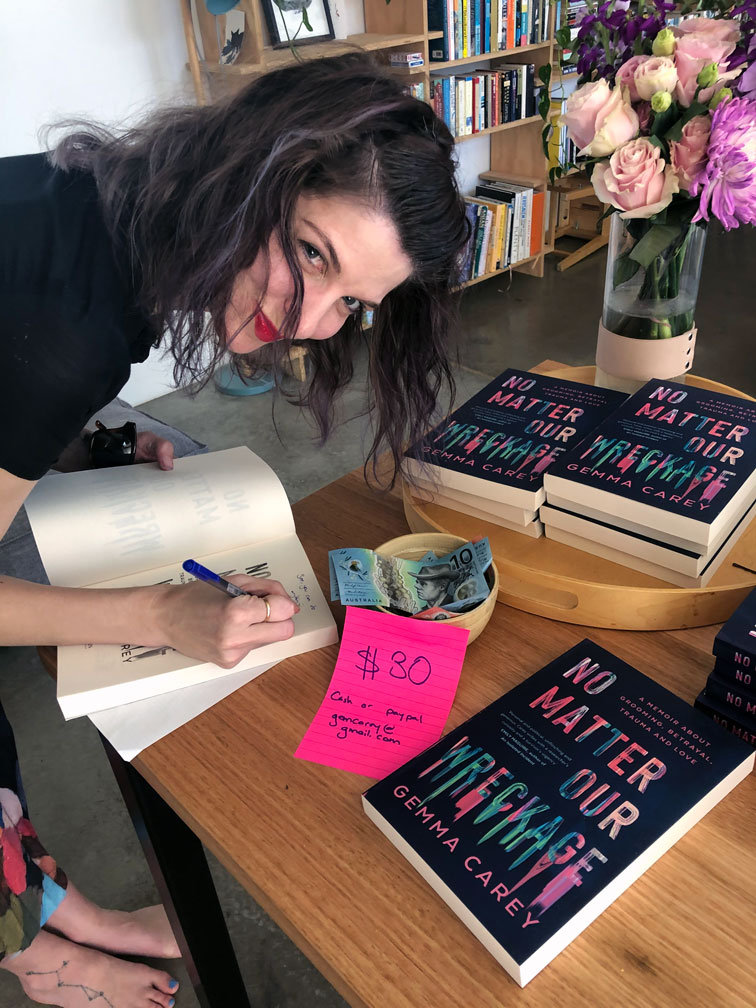
IMAGE: Gemma Carey signing books at the launch of her memoir, No Matter Our Wreckage (photo by Ben O'Mara).
Memoir: slow violence, a weird delerium


REVIEW
Ali Alizadeh
January 2025
Pascal Plantea's film Les Chambres Rogues (Red Rooms) takes viewers on a terrifying journey into mental spaces as dark as the horrors of the dark web.
REVIEW
Phoebe Lupton
December 2024
Naomi Klein's Doppelganger: A Trip into the Mirror World draws on memoir-cultural criticism to reveal a disturbing lack of kindness in the era of misinformation.
More on the blog
Lost Souls Magazine in print and online is proudly independent.
We are based in Melbourne and Canberra.
The design and development of this website was based on a scoping of best practice and relevant examples. Work included websites for Heat Magazine, Meanjin, Overland, The New Yorker, Rue Morgue, Dark Mountain, The Dark and Weird Studies.
We acknowledge, recognize and pay our respect to the Ancestors, Elders and families of the Bunurong/Boonwurrung, Wadawurrung and Wurundjeri/Woiwurrung of the Kulin who are the traditional owners of lands where we work and live in Victoria, and the Ngunnawal who are the traditional custodians of land in the Australian Capital Territory.
