-v13.png)

.png)
.png)
Undertone (2026), dir. Ian Tuason. Image source: DigitalCommons@UNO / Journal of Religion and Film.
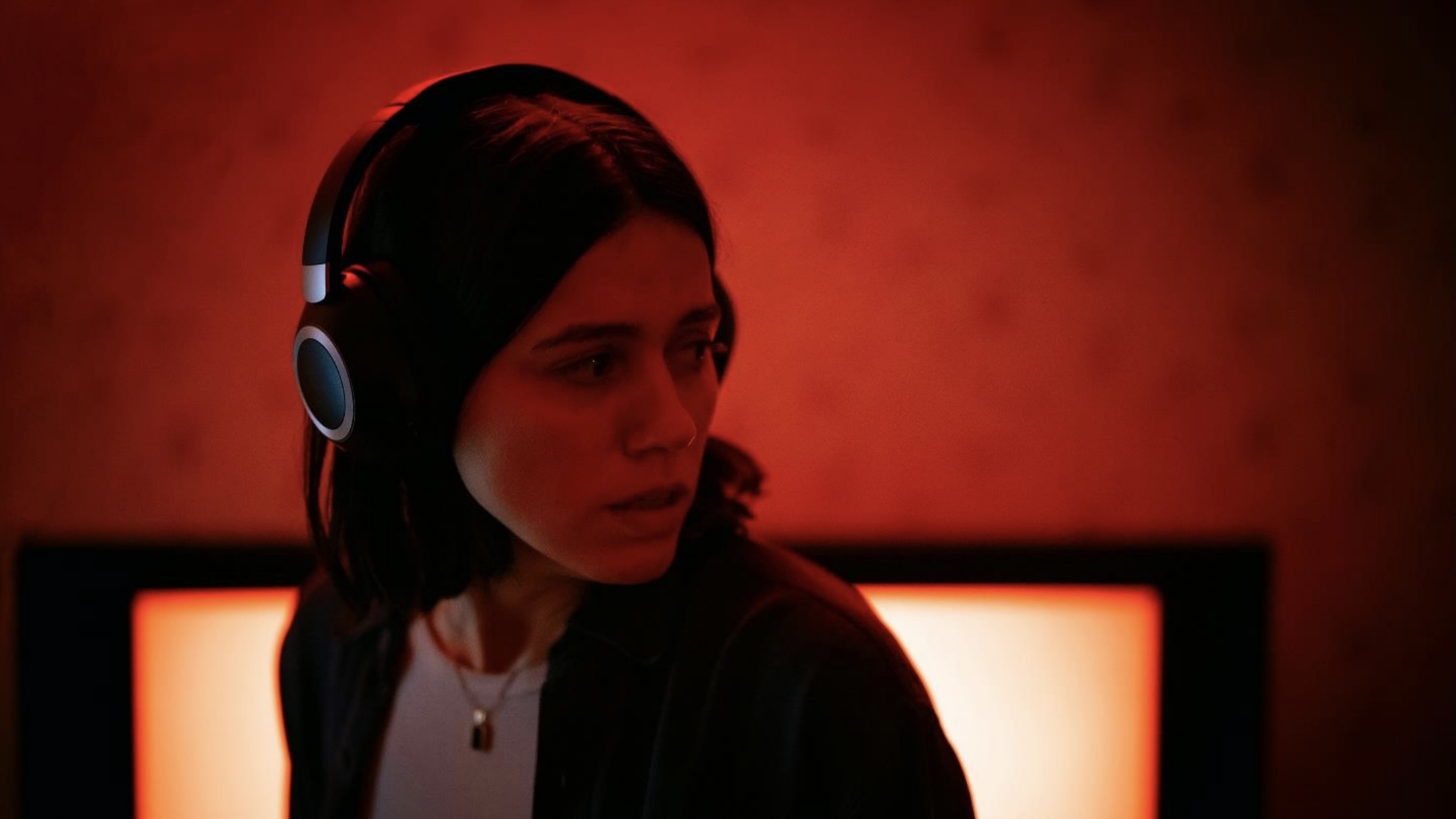
Ian Tuason's minimalist horror, Undertone, follows the story of a podcaster disturbed by a series of strange audio files. The small scale of the film has not diminished its power, with Hollywood and audiences across the world taking notice. Mariana Pinheiro offers a fascinating deep dive on the film's specific use of sound and how it contributes to the 'intimacy' of modern horror cinema.
MARIANA PINHEIRO, Thurs 14 May 2026
The film centres around Evy, who hosts a paranormal podcast and looks after her sick mother, while her home life starts to become increasingly disturbed by a number of anonymous recordings. This basic idea provides the film with its emotional weight because Evy is already in a situation where she has to provide care, attention, and take on responsibility before the horror aspect fully appears. What starts off as listening for her job slowly becomes tied together with listening as a form of care, which causes the home to feel less like a safe place and more like a site of vulnerability.
Horror has long recognised that what people hear can impact them more profoundly than what they see. An image might shock, but sound enters the mind differently; it bypasses distance, settles in the body and disturbs from the inside. A voice in the dark, a breath coming through static, a sound that has no clear source… These things are not just extras in fear but some of its strongest forms. Undertone builds its horror not through visual spectacle, but through the act of listening. Sound is never neutral in this setting. It carries with it memory, intimacy, intrusion, and grief. It can provide comfort, but it can also lead to contamination.
What makes this film particularly effective is how it turns listening into a form of exposure. Its horror does not stay at a distance but moves through mediated sound, such as recordings, phone calls, and voices that feel unnervingly close, until the act of listening itself becomes a point of vulnerability. In one playback sequence, a voice comes through dense static, fragmented and unclear, yet too close to be safely external. Evy pauses, rewinds and listens again; the repetition does not make the sound clearer but instead makes its presence feel stronger. What starts as documentation shifts into intrusion. To hear in this context is not just to receive sound, but to let it cross the boundary between outside and inside.
The podcast format shapes this experience in important ways. Events are mediated through recorded segments, narration and fragmented timelines that are put together after the fact. Recordings are replayed, reinterpreted, and shared across different moments, so what is heard is never entirely immediate but always already framed. This creates an initial distance: the voice is not just present but presented, shaped by selection and repetition. Yet this mediation does not make the experience more stable; it makes it more unsettling. Because recordings come back without a clear origin or resolution, they disrupt any secure sense of sequence or causality. At the same time, the intimacy of the podcast voice (its closeness to the ear, its confessional tone) pulls the listener in. We listen as Evy listens: closely, repeatedly and with uncertainty. Mediation becomes the way in which proximity and doubt are heightened rather than resolved.
Silence also plays a significant role. In one sequence, a recording cuts off suddenly, and the soundtrack drops to almost nothing: no music, hardly any ambient sound, just an emptied acoustic field. The edit does not resolve the sound that was there; it removes it, leaving a gap that feels too complete to be natural. The scene focuses on Evy in this suspended quiet, where any return of sound would feel like an intrusion. This is not neutral silence but a charged absence, one that reorganises attention and stretches anticipation. The tension comes not from what is heard, but from how long nothing lasts.
The domestic setting heightens this instability in sound. The home does not need to change visually to feel haunted; it only needs to become sonically unreliable. A voice from another room, a recording that continues after it should have ended, a silence that lasts too long: these are enough to make the familiar space feel hostile. Unlike many horror films where the home remains structurally understandable, even when threatened, such as in The Conjuring or A Quiet Place, Undertone undermines the very idea of containment. Sound does not respect spatial boundaries. It travels, repeats and returns, making it impossible to maintain a stable distinction between inside and outside.
At the heart of this instability is maternal dread, which shapes the emotional core of the film as well as its acoustic logic. Evy’s listening is guided by care; she moves through the house attentively, alert to small changes in sound while staying close to her ill mother. In one moment, a recording starts to bleed into the ambient quiet as she stands near her mother’s room, the voice coming through static in a way that is indistinct yet insistently present. The sound does not completely separate from the environment; it merges with it, making it hard to tell if it comes from the recording or from the space itself. This uncertainty cannot be separated from the demands of care. Evy cannot disengage from listening, because her attention is already shaped by responsibility. The horror lies not just in the presence of the voice, but in the impossibility of not hearing it.
One could say that the film is less focused on maternal dread and more on isolation or trauma in a broader sense. Evy’s experience could be seen as the result of grief, exhaustion and prolonged exposure to illness, with the recordings acting as psychological projections instead of external intrusions. Similarly, the podcast format might be viewed as creating distance, mediating events through narration and turning them into content to be processed rather than directly experienced. From this perspective, the film’s restraint could be interpreted as ambiguity instead of invasion.
However, these interpretations ultimately reinforce the film’s effect. Whether the sounds come from outside or inside, they are experienced as intrusion. The recordings do not stay abstract; they have tangible effects on Evy’s perception, infiltrating her environment and destabilising her sense of reality. Likewise, mediation does not protect the listener but pulls them in deeper, collapsing the boundary between narration and presence. What matters is not where the sound originates, but what it does: it lingers, repeats and transforms listening into exposure. Even the absence of visual spectacle heightens this effect. Where spectacle fixes fear in what can be seen, Undertone allows it to circulate in a way that is unresolved, persistent and hard to contain.
What the film ultimately shows is that its horror comes not from any single element but from the coming together of its formal and thematic concerns. Maternal dread creates a state of vigilance in which listening becomes unavoidable; the domestic setting provides the intimate space in which that vigilance is maintained and the film’s religious undertones frame intrusion as something that goes beyond the self, echoing older fears about possession and exposure. Together, these components create an acoustic environment where the home can no longer serve as a boundary and where care itself becomes a site of vulnerability.
Undertone indicates a broader trend in modern horror that moves away from spectacle and shifts towards forms of intimacy that create unease from within. Fear does not depend on what is shown but rather on what continues: sounds that echo, remain and prove difficult to contain. What is left is not the visual representation but rather the feeling it generates.
In Undertone, horror does not arrive abruptly. It takes its time to settle.
Mariana Pinheiro is completing her Master’s in Comparative Studies at Universidade Aberta, Portugal, focusing on literature, cinema, horror, and intermediality. Her writing often looks at horror through questions of embodiment, sound, religion, gender, and affect, particularly how fear is generated through form rather than just through narrative.
Statical Horror: Sound and Maternal Dread in Undertone


REVIEW
Ali Alizadeh
January 2025
Pascal Plantea's film Les Chambres Rogues (Red Rooms) takes viewers on a terrifying journey into mental spaces as dark as the horrors of the dark web.
REVIEW
Phoebe Lupton
December 2024
Naomi Klein's Doppelganger: A Trip into the Mirror World draws on memoir-cultural criticism to reveal a disturbing lack of kindness in the era of misinformation.
More on the blog
Lost Souls Magazine in print and online is proudly independent.
We are based in Melbourne and Canberra.
The design and development of this website was based on a scoping of best practice and relevant examples. Work included websites for Heat Magazine, Meanjin, Overland, The New Yorker, Rue Morgue, Dark Mountain, The Dark and Weird Studies.
We acknowledge, recognize and pay our respect to the Ancestors, Elders and families of the Bunurong/Boonwurrung, Wadawurrung and Wurundjeri/Woiwurrung of the Kulin who are the traditional owners of lands where we work and live in Victoria, and the Ngunnawal who are the traditional custodians of land in the Australian Capital Territory.
.png)
